22/10/2026 01:21
Can New Members See the Size Guide? Telegram Chat History for Cambodian Container Wholesalers

A useful product guide does little for a buyer who cannot find it after joining your Telegram group. For Cambodian wholesalers selling reusable food containers, that missing context can mean repeated questions about lid compatibility, confusing photographs or enquiries for the wrong model. Before promoting the group, check what a newcomer can actually read. This workflow connects an archive review, a practical access test and a clear enquiry route. It also explains where SMM panel records belong: they can document a service request, but purchased membership does not establish that anyone studied your guide or wants to buy.
1. Define the promise behind the invitation
Start with the reason someone should join. A hypothetical Phnom Penh wholesaler might invite small catering businesses to consult a container-sizing guide before asking about replacement lids. That promise is specific: readers should be able to identify their container, understand where to measure and send the shop enough information for a useful answer.
Write the promised resource down before preparing promotional posts. Identify its photograph, explanation and enquiry instructions. If the invitation says that the group contains a fitting guide, a newcomer should not have to wait for an administrator to return from a delivery. Decide what must be available immediately and what requires a personal response. This becomes the acceptance test for the group, rather than simply checking whether an invitation opens.
2. Understand what the history setting controls
Telegram’s FAQ describes persistent group history as a control over newcomers’ access to earlier messages. It also explains that public groups make their history available for viewing. These are access characteristics, not assurances that readers will find the right explanation. The supporting reference is Telegram’s FAQ, listed in the sources.
Do not assume every group offers the same switch. Telegram’s technical documentation identifies restrictions involving public chats and groups with forum functionality. Use the controls available in your actual group and avoid changing its public status or discussion structure merely to make a tutorial’s menu appear. The business decision comes first: should future members be able to read this archive? The technical setting should support that decision. If the existing group cannot provide the intended experience, prepare a separate, reviewed resource instead of experimenting during a promotion.
3. Review the archive before widening access
An old customer discussion is rarely a clean catalogue. Review earlier messages for delivery addresses, payment evidence, private quotations, customer photographs and staff conversations. Also look for obsolete stock announcements and product claims that the shop can no longer support. A message that made sense to its original participants may mislead someone encountering it months later.
Sort useful material into three working categories: ready for future buyers, needs rewriting and unsuitable for a promotional audience. These are editorial categories you maintain in your notes, not Telegram features. Rebuild a sizing explanation from your own approved product photographs when necessary. Do not republish a customer conversation just because it contains a useful question. Where the archive mixes sensitive business records with product advice, a fresh customer resource may be more manageable than exposing the whole discussion.
4. Make the sizing guide understandable on its own
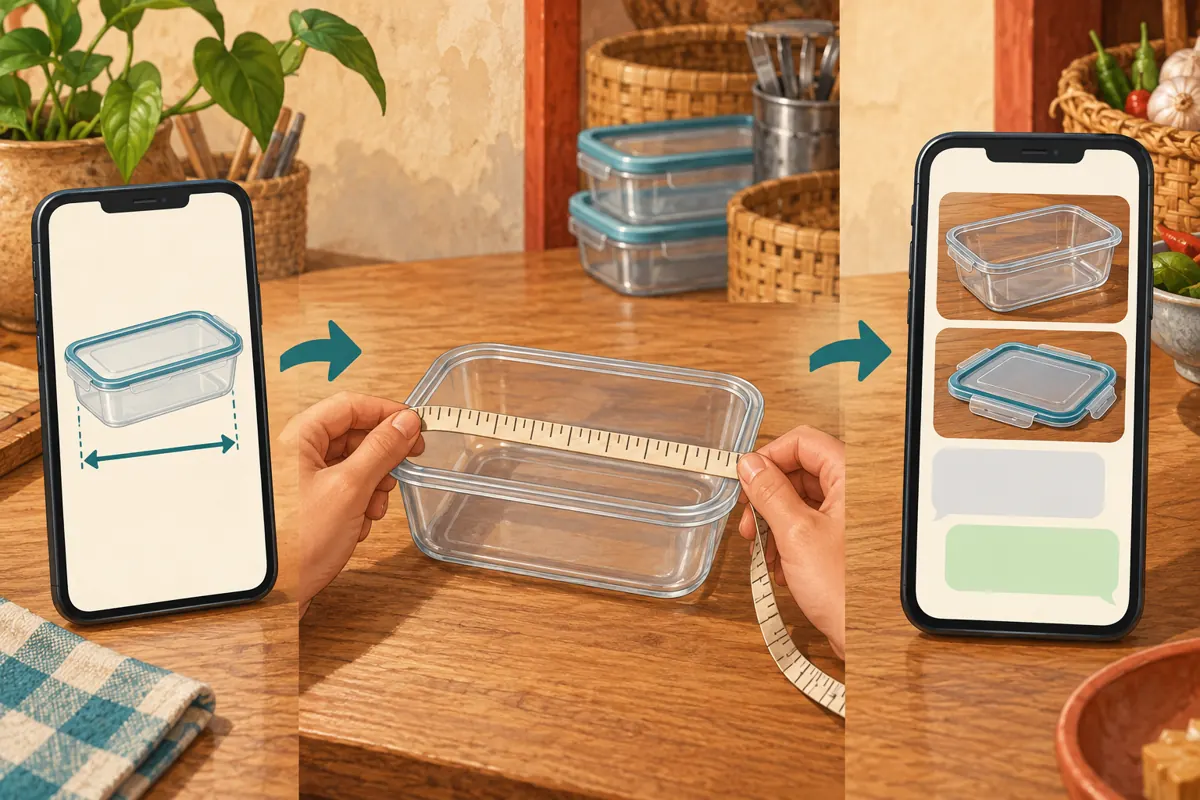
A newcomer should not need last week’s conversation to interpret today’s guide. Give each container a stable shop reference, show its shape clearly and explain whether a measurement concerns the outer rim, inner opening or overall height. Include the lid in a separate photograph when its fastening or profile matters. State the measurement unit beside the instruction.
For Cambodian customers, prepare the explanation in the language your actual buyers use, with Khmer wording reviewed by someone who understands the product. Keep genuine model codes unchanged. Avoid relying on colour alone, since two batches may look similar on a phone. Make the guide’s limits explicit: dimensions can help narrow the question, but they do not establish compatibility across different manufacturers. Invite the customer to send a clear photograph and the model reference before staff confirm a match.

5. Review the setting with the responsible administrator
Ask the person responsible for the group to open its information and management controls and locate the history setting, if available. Record the current choice and the intended outcome before changing anything. Interface wording and placement can differ, so follow the labels in the installed app rather than treating a fixed sequence of taps as universal.
For a reviewed private customer group intended to provide earlier guidance, select the available option that permits newcomers to access history. If that option is absent or unavailable, stop and identify the group’s configuration. Do not make the group public as an improvised workaround. Record when the review occurred and which resource needs testing. A saved setting is only one part of the work; the next step is checking the experience from an account that did not already have access.
6. Test with a genuinely new participant
Use a consenting colleague whose account has not previously belonged to the group. Let that person follow the same invitation route a customer would use. An administrator’s phone is a poor substitute because it already contains the conversation and represents a different access situation. Keep the test focused on the promised resource rather than browsing unrelated customer discussions.
Ask the tester to locate the sizing guide, open its photographs and explain which edge should be measured. Then ask them to find the next step for requesting a lid check. Record observations such as “guide opened, but the unit was unclear” or “invitation worked, earlier guide was unavailable.” These are different failures with different remedies. Recheck after the correction using an appropriate newcomer test, rather than assuming that a successful save resolved the original problem.
7. Fix missing context without flooding the group
If newcomers cannot access the older explanation, provide a fresh, self-contained version through a route you have verified. That may mean posting the approved guide again or making it available in a separate customer resource. Include the essential text with the pictures so readers do not need to reconstruct instructions from scattered replies. Update the promotional invitation to match the route that actually works.
Telegram supports multiple pinned messages, according to its official pinned-message announcement. A pin can help readers locate guidance, but it should not replace the newcomer access test. Keep the current guide easy to distinguish from superseded material. Avoid reposting every old product discussion in an attempt to rebuild the archive. A concise, complete explanation is easier for buyers to evaluate and easier for staff to maintain when the container range changes.

8. Turn access into a useful enquiry
Consider a hypothetical catering supplier in Battambang looking for lids for containers already in use. After joining, the buyer opens the guide and discovers that the shop needs the outer-rim dimensions, a photograph of the fastening edge and any moulded model reference. The buyer can now ask a precise question instead of sending “Do you have this size?” beneath an unclear image.
Prepare the response workflow too. Staff should acknowledge what they can identify, name anything still missing and distinguish a possible match from a confirmed fit. Move delivery details and individual quotations into the shop’s designated private conversation. The public guide should explain the enquiry process without inviting people to expose personal information. Promotion becomes useful when the destination helps a real person take this next step, not merely when the group becomes larger.
9. Keep SMM service claims separate from access testing
The supplied top-smm.com catalogue includes “Telegram - Channel/Group Members ~ Max 1M ~ 𝐍𝐎 𝗥𝗘𝗙𝗜𝗟𝗟 ~ 50k/days ~ INSTANT”. Its category is “Telegram - Members [Bot Account] ᴺᴱᵂ”, and the supplied description is empty. Treat the title as a catalogue label, not independent verification of its speed, capacity or any audience characteristic.
That listing cannot establish whether a human newcomer can understand your sizing guide. Purchased membership or engagement is not evidence of genuine interest, sales, ad delivery or Cambodian users. It also does not establish official Telegram affiliation. For this task, a consenting person’s access test provides the relevant evidence. There is no need to purchase a member service to perform it.
If a separate panel request is being considered, keep its exact service name, destination and stated terms in its own record. Check current platform rules and service conditions before proceeding. Do not give a provider account credentials or administrative access to solve an ordinary content-navigation problem.
10. Review comprehension before increasing promotion
After sharing the invitation with a relevant, consenting audience, review the questions people actually ask. Repeated confusion about the same measurement suggests the illustration or wording needs work. Requests for a discontinued lid suggest that an older message still appears current. Difficulty locating the guide suggests a navigation problem. Each observation points to a concrete editorial change.
Keep these findings separate from membership totals and panel order statuses. A useful review note describes the problem, the revision and what a subsequent test showed. Avoid presenting a few conversations as a representative survey of Cambodian demand. Also avoid describing everyone in the group as a customer. The operational goal is modest and testable: a new visitor can reach accurate guidance and knows how to ask a relevant product question.
Frequently asked questions
Should every Cambodian shop group make its earlier history visible?
No. Decide according to the contents and purpose of the group. A reviewed product discussion may be suitable for future buyers, while an archive containing delivery details or individual negotiations may not be. If useful guidance is mixed with unsuitable material, prepare a separate customer resource and test that destination before promoting it.
Why can the administrator see a guide that a newcomer cannot?
The administrator’s existing access does not reproduce the newcomer’s experience. Record the group configuration, when the person joined and which message they tried to open. Test the specific resource from the new participant’s account. If it remains unavailable, provide a complete current guide through a verified route rather than repeatedly sending the same inaccessible reference.
Does a visible guide prove that customers understand container sizes?
No. Opening a photograph establishes access during that test, not comprehension. Ask the tester which edge they would measure, what unit they would use and what information they would send the shop. An incorrect explanation gives you a practical reason to revise the guide before inviting more people.
Can a Telegram member service replace the newcomer test?
No. A member-service delivery record cannot explain what someone saw, whether they understood a measurement or whether they intend to purchase. Use a consenting human tester for usability questions. Evaluate genuine product enquiries separately, and do not present purchased membership as Cambodian customer demand.
What should staff do when the container range changes?
Review the guide against the new products, replace obsolete photographs and clearly identify the current version. Check that the invitation still describes the available resource accurately. Then repeat the access and comprehension checks for the affected instructions. Preserve necessary internal product records separately from the customer-facing explanation.
Explore the current service catalogue, create an account, or ask a specific question through support tickets.
- Telegram FAQ — Groups and Channels
- Telegram API — History visibility control and configuration restrictions
- Telegram — Pinned Messages 2.0, Improved Live Locations, Playlists and More
Prepared with AI assistance. Illustrations explain the workflow and do not represent customer results.